 Cairo Day Tours
 Luxor Day Tours
 Alexandria Day Tours
 Luxury Travel Packages
 Classic Travel Packages
 Exclusive Access
 Leisure Holidays
 Adventure Travel
 Day Tours
 About us
 Blogs
Blogs
 Testimonial
 Why Travel With Us
.svg) Contact us
Contact us
Colossi of Memnon
- Home...
- Luxor Attractions
- Colossi of Memnon
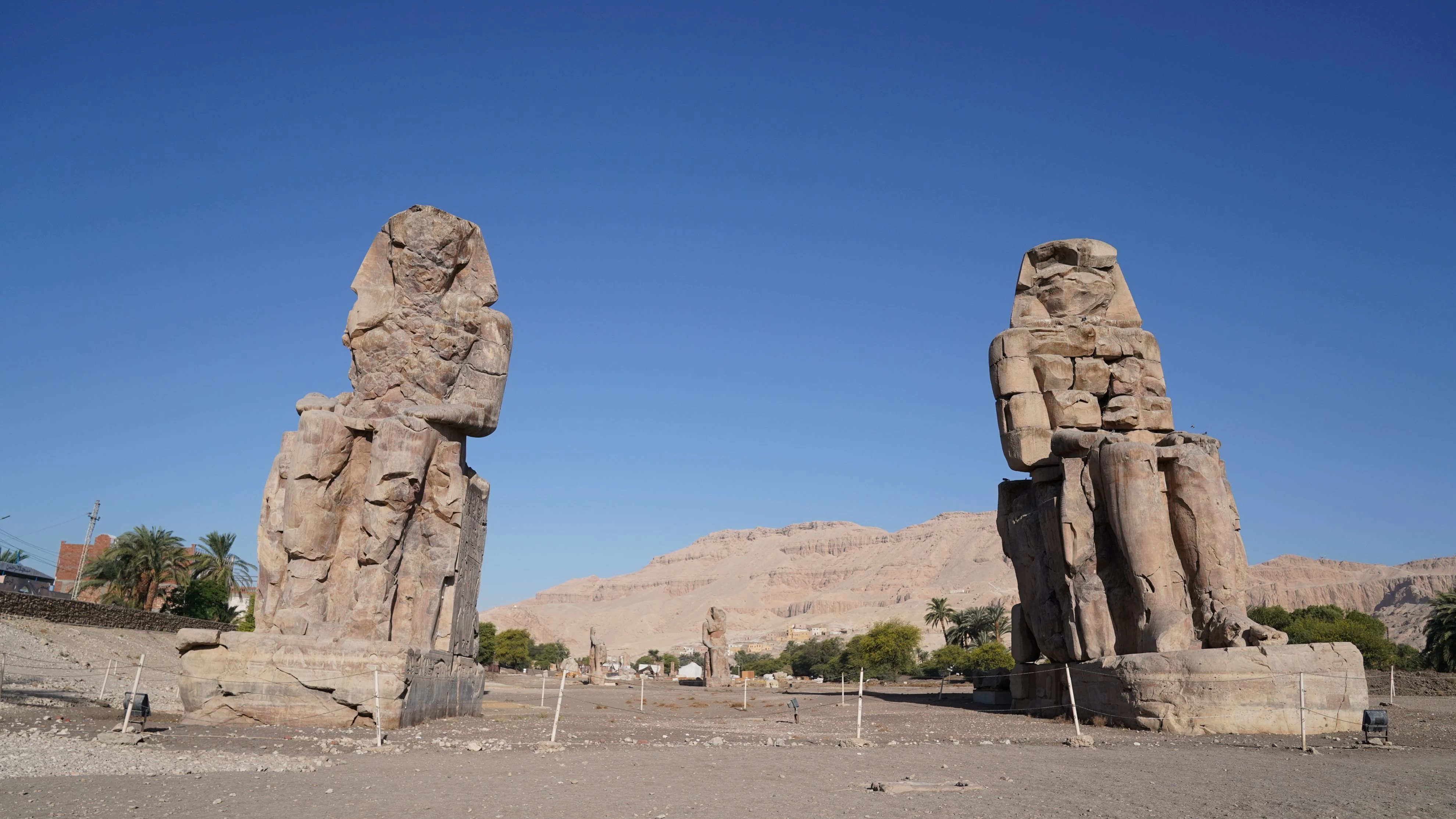
The Colossi of Memnon are two massive stone statues located on the west bank of the Nile near Luxor. They are among the most famous surviving monuments from ancient Egypt’s New Kingdom period.
These statues were built during the 18th Dynasty by Pharaoh Amenhotep III, one of Egypt’s greatest rulers. Amenhotep III reigned for more than 30 years and was married to Queen Tiye. He was also the father of Pharaoh Akhenaten.
The statues are the remaining fragments of Amenhotep III’s vast mortuary temple, which was once one of the largest temples in ancient Egypt. Much of the temple disappeared over time due to:
The name “Memnon” does not come from ancient Egypt. It was given later by the Greeks.
After a major earthquake damaged one of the statues in 27 BC, cracks formed in the stone. During the early morning, wind and temperature changes passing through these cracks created a mysterious sound.
Greek travelers associated this sound with Memnon, a legendary Ethiopian hero from the Trojan War who was said to have died at Troy. They believed the sound was Memnon “singing” or greeting his mother, the goddess Eos, at sunrise.
Because of this legend, the statues became known as the Colossi of Memnon.
In the 2nd century AD, Roman Emperor Septimius Severus ordered restoration work on the damaged statue. Once the cracks were repaired, the mysterious sound disappeared permanently.
These statues remain one of the most iconic landmarks in the Theban necropolis and continue to welcome visitors entering the royal west bank of Luxor.
Discover more tips, guides and insights to plan your perfect trip.
-webp.webp "Things to do in Luxor")
Learn about the daily life of the ancient Egyptians
Read more
Find quick answers to the most common questions about your trip. Our FAQ section covers everything from travel requirements and safety tips to local customs and currency information. Interested to know more? Contact Us!
Licensed tour guides must maintain a certification from the Egyptian Ministry of Tourism and Antiquities, along with membership in the Egyptian General Tourist Guide Syndicate. These certifications ensure that our guides are fully approved and registered as professionals with the Egyptian government authorities.
The busiest tourist season is from September to April. The weather in Egypt is generally sunny and dry, with lower temperatures in the winter months that make for pleasant travel through Upper Egypt.
Tipping is greatly appreciated, based on the quality of the service you receive. We suggest around $5-$8 per day for your driver, and $10-$15 per day for guides. Tipping can be done in cash, either as Egyptian pounds, US dollars or Euros. For non-Egyptian currency, bills in good condition (no rips or tears) are preferred.
You can get a 30-day tourist visa upon arriving at Cairo Airport. Please bring $25 in USD cash with you; you will get the visa documentation before the immigration desk at the airport, and the immigration officials will review and stamp your passport. Our staff will meet you after you disembark the plane to facilitate this process and ensure you are able to get through security smoothly.
Most tours can be walking-intensive, primarily on flat ground. Visiting the Pyramids and the Sphinx requires some walking over flat but uneven ground and sand. Entry into many of the tombs and Pyramids can be physically demanding, with low ceilings, steep staircases and narrow passageways.
Each day’s tour is a full day, estimating 8 to 10 hours - though we have built in plenty of time to rest, enjoy a coffee or a meal, or explore on your own.
Comfortable, closed-toe walking or athletic shoes are recommended as there may be areas with uneven pavement. Locals in Egypt often dress modestly, so visitors often feel more comfortable in clothes that cover their shoulders and knees (t-shirts or long sleeved shirts, capris, pants). You may wish to bring a hat for sun protection, as well as a scarf or light jacket for evening.


-webp.webp "Things to do in Luxor")


.svg)